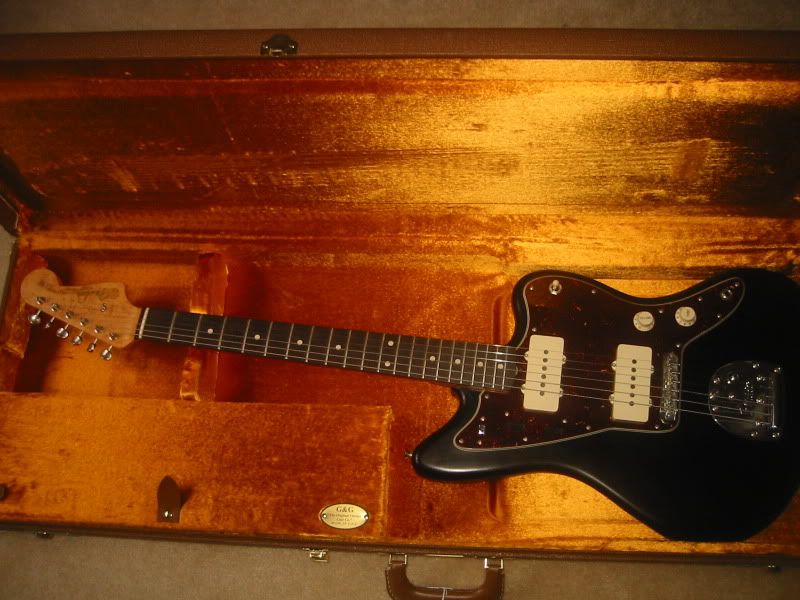
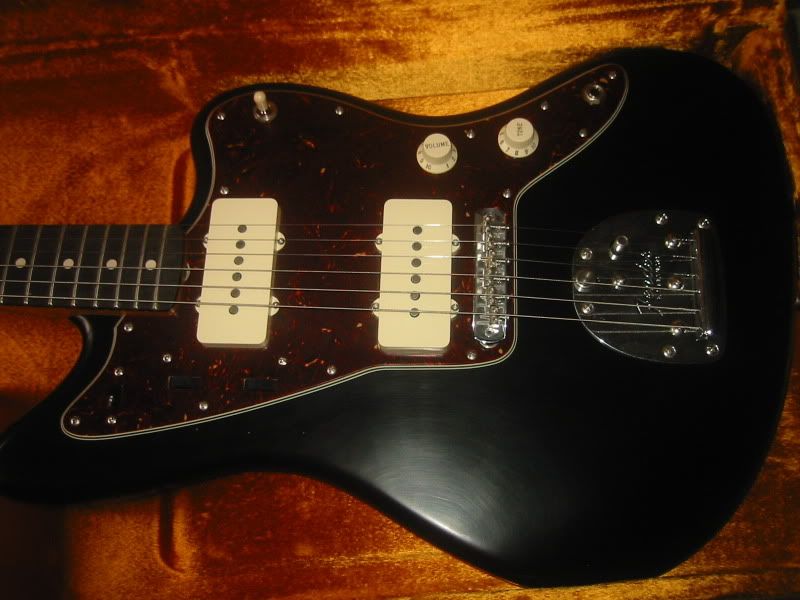
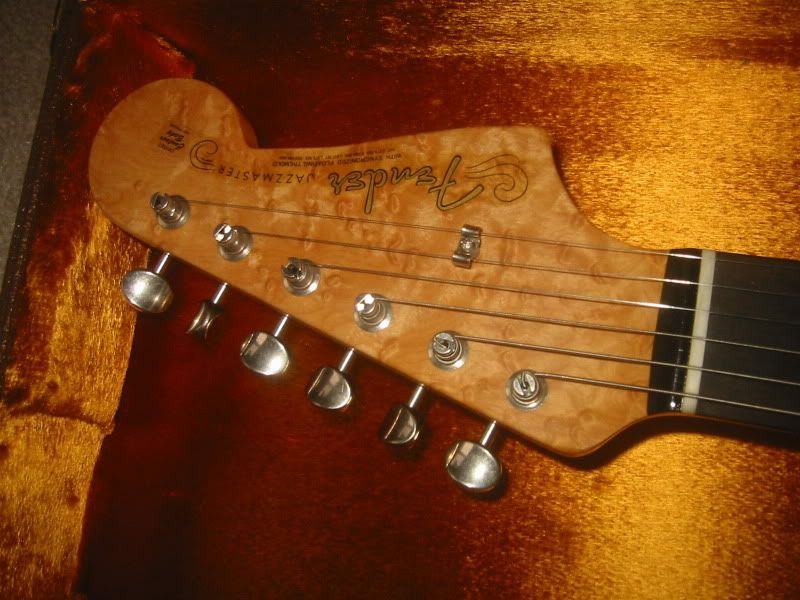
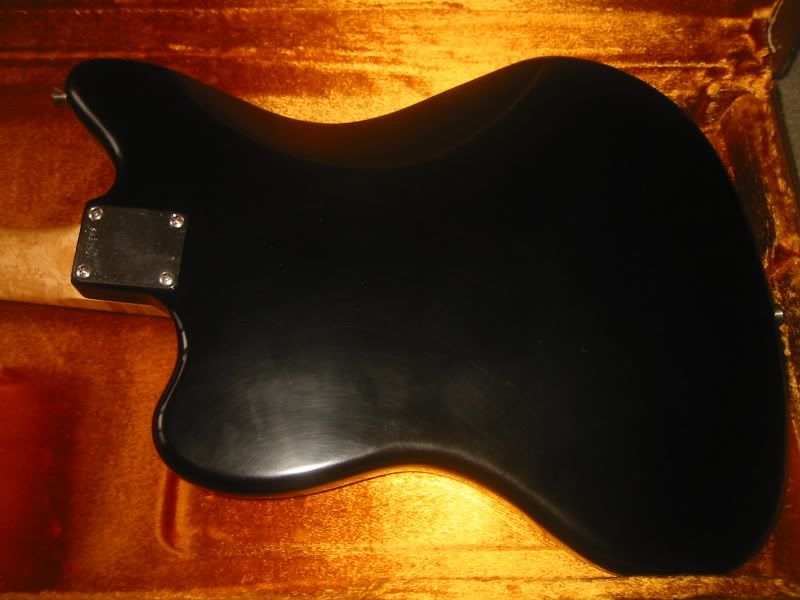
有歷史價值的便宜沖浪吉他
60年代沖浪搖滾音樂流行, 青少年紛紛組自己的小樂隊在車房地下室練習, Fender公司在1965年把公司賣給CBS前針對市場需要設計了一把合適年青人口味口袋的吉他, 價位在Duo Sonic 和Telecaster之間, 稱為野馬(Mustang), 相當成功.
愛沖浪吉他的我, 找野馬吉他很久, 一直沒有看到全部原裝的, 不是重新塗裝就是換了拾音器, 今天在eBay上看到一把狀況不錯的原裝琴, 只有Pick guard 換成68年的, 原來72年的Pick guard 一角斷掉, 還留在盒內。 雖然不是我要的1965年版﹐但難得看到如此乾淨便宜的野馬﹐就買下來了。
1965-1972 年規格沒有大變動﹐1972年以後才做較大的改變﹐一般人比較要收集1972以前的野馬。 Mustang有 24"和22 1/2"長短兩種,, 我這把是24"的, 雖然短的收藏性高些, 我還是喜歡比較長的. 比較好彈. 古董野馬藍色最值錢, 白色紅色次之, 不過藍色白色很容易褪色, 我的是1972年才有的漸淡日出色(Sunburst)
1969-1972年Fender改做琴身上有賽車條紋的Mustang Competition琴, 收藏性高但基本上是相同的琴. 1972年 Competition型號停產後又回來做普通型號, 加了一些顏色選擇. 到了1982年後停產, 現在的野馬都是進口琴.


 http://fendermustangstory.com/default.htm
 In the spring of 1956, Fender released a pair of "student" electrics with 22-1/2" scale and 21-frets. The one pickup version was the Musicmaster ($119.50) and the two pickup version was the Duo-Sonic ($149.50). Both of these guitars were equipped with anodized gold finished metal pickguards, a one piece maple neck and stark white pickup covers. Both models had one volume and one tone control and used the same knurled knobs found on the Telecaster & Precision Bass. The Duo-Sonic had a three position switch on the shorter horn of the body. These models were offered only in Desert Sand (sort of an opaque "Blond" color that was already being applied to lap steels). In mid-'59, the fingerboard was changed to a slab of Rosewood on these models, along with the rest of the Fender line. At that time the standard finish was changed to a tan color (name unknown), the pickup covers were changed to dark brown plastic and the pickguards were changed to a cream colored plastic. By mid-'61 the standard color was changed to Shaded Sunburst (sometimes called "Maroon Burst" or Sienna Burst) and the plastic pickguards became stark white. By mid-'62 the fretboard went from slab to curved Rosewood, and by mid-'63 the standard color changed from Shaded Sunburst to White. White guitars were fitted with Tortoise Shell pickguards with stark white pickup covers. These models were unchanged until mid-'64 when the overall design was upgraded to match the new Mustang. The Duo-Sonic's selector switch was changed to two slider switches also found on the Mustang. The color availability was commonized with the Mustang offering also. These models were then made available with a 24" scale and 22 frets and were reintroduced (at the same time as the Mustang) as the Musicmaster II and Duo-Sonic II respectively. The optional scale lengths (22-1/2" and 24") were shared with the Mustangs.
Check out the Musicmaster and Duo-Sonic Photo Gallery for more info on these guitars.
The Fender Mustang was introduced in August 1964. This guitar was essentially a Duo-Sonic with a Dynamic Fender Vibrato. It was available in three colors: Red, Blue, and White. Although similar to Fender's custom colors of the time: Dakota Red, Daphne Blue, and Olympic White, these namings were apparently never used on the Mustang. They were just plain Red, Blue, and White. The Red and Blue ones came with white pearl pickguards (white pearl-black-white), black pickup covers with no pole piece holes, and black slider switches. The White ones came with red tortoise-pearl pickguards (red pearl-black-white) and white (creamish) pickup covers and white slider switches. The white slider switches were made of different material than the pickup covers and tended to stay whiter and not age to a greenish gray color like the pickup covers.
The specifications for Fender Mustangs change relatively little over the years. Here are the basic specs of the Mustang in 1964:
- Poplar or Mahogany slab body (Note: as of March 2000, I no longer believe Mustangs were ever made with Alder body wood.)
- "Patriotic Colors" Red, White, and Blue
- Maple neck with rosewood fingerboard
- Two single coil pickups with black base plate
- Small headstock with Transition Fender Logo
- One string guide
- Kluson tuners with plastic oval knobs
- White dot finger board markers (sometimes Faux pearl dot inlays)
- White pearl neck side markers on the seam of maple and rosewood
- Brass shielding plate in the pickup, slider switch, and control cavity
- Two slider switch ON-OFF-PHASE for each of the two pickups
- 12 screw pickguard
- 3 screw control plate
- Dynamic Fender Vibrato
- White Tremolo Bar Tip
- L-series neck plate
- One volume one tone with black plastic knobs with white marker line
- Headstock numbers (early '64): DES. 186,826 PAT. 2,960,900 2,741,146 & PAT. PEND.
- Headstock numbers (late '64): DES. 186,826 PAT. 2,960,900 2,741,146 3,143,028 & PAT. PEND.
- 24" scale with 22-frets standard (optional 22-1/2" scale with 21-frets). Most '64 Mustangs appear to be shipped with short scale length necks with "A" neck widths (1-1/2").
A couple of things changed in late 1965 to early 1966. The biggest change was the enlargement of the headstock, in line with the BIG HEADSTOCK found on other Fender guitars of the time. The tuners also changed to "F-keys" with sort of square-ish white plastic pegs. The neck plate changes to "F-series" plates. The pickup's base plate changes to gray color. An additional patent number appears on the Headstock. So, to summarize the changes:
- Large headstock
- F-key tuners with white plastic squarish knobs
- F-series neck plate
- Single coil pickups with gray base plate
- Headstock numbers: DES. 186,826 PAT. 2,960,900 2,741,146 3,143,028 2,817,261 & PAT. PEND.
Around 1970, the regular Mustangs were discontinued and replaced by the Competition Mustangs. None of the feature on Mustangs really change until about 1973 and since a '67 Mustang isn't really worth more than a '72 Mustang, I don't think anybody really took great interest during this era unlike the more expensive Stratocasters and Telecasters. Besides, Fender stopped dating the neck in this time frame and started using codes that require deciphering, making it doubly difficult to tell the manufacture date (yes, you can still look at the pot dates). Greg Gagliano has deciphered the neck coding of this era, check his article out in the link just below. I know as a fact that there are Red, White, and Blue Mustangs with body contours so my guess would be that the regular Mustangs continued into 1969 and was replaced by the Competition Mustangs sometime during 1969. The Competition Mustangs were made in lefty versions also, although they were probably a special order item.
Here's a 1970 Fender Color Chart. It shows the following colors for the Mustang:
- 510 Competition Orange
- 511 Competition Burgandy (I think they really meant Competition Blue)
- 512 Competition Red
This chart also shows the plain "Red" (color code 515) and plain "Blue" (color code 517) used on the Musicmasters and Duo-Sonic. These colors were used on the pre-'69 Mustangs and were not called "Dakota Red" or "Daphne Blue." Competition Orange is not shown on the 1972 Color Chart so it looks like this color was dropped after one or two years.
70's Fender Neck Code Deciphering
Around 1972, the Competition Mustangs were discontinued. At about the same time, the pearl pickguards were discontinued and the pickguard was changed to a regular white plastic pickguards (white-black-white). 3-tone Sunburst, Natural, Walnut, Black, White, and Blonde were colors available in the post-Competition era. The Fender Logo changes to the black modern logo in 1972. Around 1974, the second string tree was added to the headstock, a bit later than Stratocasters and Telecasters - Competition Mustangs (1970-1972) typically only have one string guides but black pickguard Mustangs (1976 -1982) all have two string guides. I owned a 1974 that had two string guides. Fender probabaly resisted adding the second string guide on the Mustang to save 10 cents on production cost.... The "F-key" tuners now have chrome squarish knobs and are commonized with Stratocasters and Telecasters. The body of this era can be Poplar or Ash. The Ash body is gradually reinstated on non-Blond Stratocaster from around this time. The Ash body appears to have been used on Blonde and Natural colored Mustangs only. The side marker dot changes around this time to black dots on the maple part of the neck.
- Competition Colors discontinued
- Poplar or Ash body
- Modern black Fender Logo
- White-black-white plastic pickguards
- Second sting guide on headstock
- F-key tuners with chrome squarish knobs
- Black plastic side marker dots
How do the switches on the Mustang work?
Author: Webmaster The mustang switches are simple on/off switches which control the direction of current flow through the pickup it is positioned above.
switch in middle (off) position:
-0-
switch in back (towards bridge) position:
0--
switch in forward (towards neck) position:
--0
both pickupsoff:
-0- -0-
both pickups on:
0-- 0-- or --0 --0
both pickups on, out of phase with eachother:
0-- --0 or --0 0--
All the combinations:
| -0- -0- | both pickups off |
| -0- 0-- | neck pickup on (back) |
| -0- --0 | neck pickup on (forward) |
| 0-- -0- | bridge pickup on (back) |
| 0-- 0-- | both pickups on, inphase |
| 0-- --0 | both pickups on, out of phase |
| --0 -0- | bridge pickup on (forward) |
| --0 0-- | both pickups on, out of phase |
| --0 --0 | both pickups on, in phase |
.