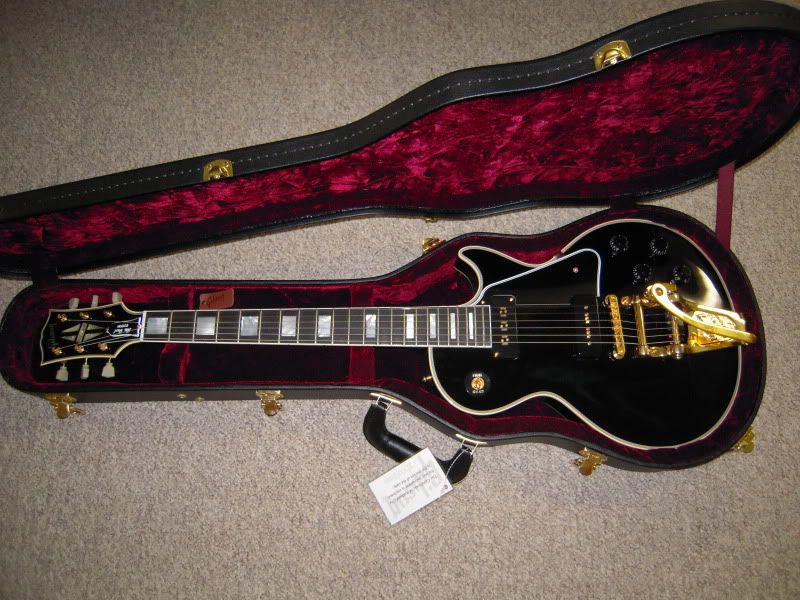
在Naperville Music吉他店看到新的 2011年1954 Les Paul Custom Shop RI, Mike 告訴我他等了10個月才從 Gibson 拿到這把琴. 研究半天後決定買了這把工廠訂價超過$6500美金的吉他, 雖然Mike給我相當好的價格, 花了我兩把吉他 ( Suhr Classic T 和日本Tempo古董吉他 ) , 一把貝士 (Lakland 5 string) 才換到, 我覺得還是值得.
吉他上有我喜歡的用的Bigsby大搖, 加級的Gloss 黑亮漆讓這位黑美人顯的更亮麗. Bridge PU是我熟悉的P90, Neck PU是是我沒有用過的Alnico V "Staple" pickup. 在店裡試過覺得滿意. 第一代的1954年黑美人(Black Beauty). 音色比第二代的1957年黑美人更合我胃口.(3個PU的1957年Les Paul Custom Shop RI 還更貴)
有了這把54 RI的Bridge P90 PU, 原來有的帶著2xP90的R6似乎多餘了, 我答應沙漠嫂吉他收藏數量只減不增, 只換不買, 是否接她回家呢? 告訴Mike幫我留一天.
有這麼巧! 過去換過琴的朋友 Jeff 當天晚上 打電話問我對一把收藏性很高的50週年 Custom Shop ES335紀念琴(只生產200把)是否有興趣? 他想換我的 Gold Top R6?
不但解決我的苦惱, 而且不是想學爵士吉他嗎? 正中我下懷, 就決定來個Gibson吉他大換血. 把R6和Jeff 換ES335, 向Mike 買下這把黑美人, 和原來的R9, 留下此三把, 代表Gibson 重要年代的吉他和三種重要的PU都包括了. 也滿足沙漠嫂的規定和自己的原則.
54RI Bridge 的P90 P/U似乎比我原來R6的 P90 暖(Mellow), 我想可能是54用整塊的Mahongany 木, 56用Maple Top的原因. 54RI比我原來R6輕一些(沒有鑿孔或空心). 54RI 有Neck Alnico V P/U音色的選擇多一些. Alnico V 也適合我將來想學的爵士吉他, 就決定吧.
1954年是Gibson出第一把Custom Shop LP的年度, 54RI 有歷史意義. 尤其能擁有第一代的黑美人 Black Beauty (雖然是再製 RI), 有原裝的大搖Bigsby, 價格又換的不錯, 我覺得很買滿意.
下面是網上的一些介紹文章和評論:
Les Paul wanted two colors used on the Gibson guitar that would forever bear his name: gold (for its connection to all things fine) and black (because a player's hands would be easily visible against a dark background). Les got the gold in 1952, but had to wait for the black. The Les Paul Custom was introduced in 1954 and featured elegant appointments like gold hardware, multiple binding, and an ebony fretboard. The '54 Custom was also the first solidbody Gibson guitar to use the ABR-1 bridge, the familiar piece of hardware we've all come to know as the Tune-O-Matic. Matched up with a vintage-style Bigsby vibrato, it's an unbeatable combination.
Underneath it's luxurious inky finish, this historic recreation of the original 1954 Custom features a carved mahogany top, a solid mahogany back, one-piece mahogany neck with long neck tenon, an early '50s rounded neck profile, 24-3/4" scale length, and a 1-11/16" nut width. It also has multi-ply white/black binding on the body and headstock, with white single-ply binding on the fingerboard. Its finer appointments include gold hardware, an ebony fingerboard, large pearl block inlays, pearl headstock inlay, and kidney bean tuners. The original circuitry is preserved with the use of CTS pots and bumble bee capacitors in the signal path and the unique pickup array of a vintage P-90 pickup at the bridge and a rare Alnico V pickup at the neck.
The Alnico V pickup was designed in 1952 by Seth Lover and Walt Fuller for Gibson to succeed the P-90 pickup on several of Gibson's distinguished archtop jazz hollowbodies, most famously the L5 CES, ES-5, and Byrdland guitars. Similar to the P-90 in appearance, the Alnico V is easily recognized by its distinctive rectangular pole pieces. It gets its name from the stronger Alnico V magnets, while each coil has 10,000 turns of 42-gauge wire to achieve its clear, round, ringing sound. It made its debut on a solidbody Gibson in the Fretless Wonder of 1954; the Les Paul Custom, or Black Beauty.
Vintage Original Spec series instruments receive a special nitro-cellulose finish treatment yielding the patina of a gently-aged vintage guitar while handcrafting enhances comfort and playability. Each VOS model has a solid mahogany back; historically accurate long-neck tenon for strength and sustain; and period-correct neck profile, hardware, and electronics.
Features 規格 :
- Carved mahogany top
- Solid mahogany back
- Multi-ply white/black binding on top and back
- Ebony finish Gloss
- VOS aging treatment
- Gold hardware
- ABR-1 Tune-O-Matic bridge
- Bigsby tremolo/vibrato tailpiece
- 1-piece mahogany neck with long neck tenon
- 22-fret ebony fingerboard
- Pearl block inlays
- Single-ply white fingerboard binding
- Early '50s rounded neck profile
- 24-3/4" scale length
- 1-11/16" nut width
- Holly headstock veneer
- Kidney bean tuners
- Alnico V neck pickup
- P-90 bridge pickup
- CTS pots and bumble bee capacitors
- 2 volume, 2 tone, 3-way selector switch
- Vintage Reissue .010 strings
- Includes Custom Shop case, certificate of authenticity
Custom: exclusive, elite, unparalleled. When guitar star Les Paul sound down with Gibson in the early 1950s to devise the revolutionary instrument that would carry his name, he envisioned two versions of the Les Paul Model: a “standard” version with gold top finish and nickel-plated hardware, and a Custom model that would be the crème de la crème. This Les Paul Custom would be dressed in formal wear, like the tux a jazz artist might pull on for a major performance, with a high-gloss Ebony black finish, multi-ply binding on body and headstock, an ebony fingerboard with pearl block markers, a larger headstock with mother-of-pearl split-diamond inlay, and gold-plated hardware throughout. As busy as Gibson was getting its debut solidbody electric guitar into production, the Goldtop was the first model out of the box in 1952, with the Custom on the back burner for further development. With the Goldtop off and running and gathering fans fast, Gibson turned its attention to designing the Les Paul Custom in 1953, planning for a release the following year, and prepared to make it something special. In addition to Paul’s desired Custom appointments, it gave this high-end electric the best of its new developments in hardware and electronics.
Though not a guitarist himself, Gibson president Ted McCarty had seen the need for a more efficient, more adjustable bridge, and had personally designed the Tune-o-matic (ABR-1), which had individual string saddles for precise intonation adjustment, and easy height adjustment via a pair of thumb-wheels on its body-mounted bolts. The Les Paul Custom of 1954 was the first to receive this revolutionary piece of hardware, which was partnered with a stopbar tailpiece (or optional Bigsby vibrato), and its inclusion marked a major step forward in the evolution of the Les Paul in general. Also new that year, at McCarty’s behest Seth Lover, who would soon contribute to the design of the legendary PAF humbucker, developed a new single-coil pickup based on the general proportions of the P-90, but with fully adjustable Alnico V bar-magnet pole pieces for a clearer, brighter, more precise tone. Another first on the Les Paul Custom of 1954, this new Alnico V pickup (also called the “staple” pickup by some), gave added note definition in the neck position, while a traditional P-90 in the bridge position provided its beloved bite and growl. With these appointments, plus a set of upgraded Grover “kidney button” tuners, the “Black Beauty” was unveiled as the 1954 Les Paul Custom, a guitar that lives again in the form of the Custom Shop 1954 Les Paul Custom. With its lightweight, non-weight relieved one-piece mahogany body, carved mahogany top, long neck tenon, rounded early ’50s neck profile, and all the custom-grade appointments of the original—from pickups, to hardware, to finish, to inlays and binding—the Custom Shop 1954 Les Paul Custom takes you back in time 56 years to a black-tie event, where tone is the guest of honor. It’s the crème de la crème, just like Mr. Les Paul ordered, and the only way of getting your hands on this original-spec package short of rooting out a rare and prized original. All Custom Shop 1954 Les Paul Customs come with a Custom Shop hardshell case, Certificate of Authenticity, and owner’s manual and care and adjustment literative.
這篇是我看過對1954 LP 黑美人RI 最詳細的評論:Dr.P's Full Review: 1954 Les Paul Custom Black Beauty Reissue
Back in 1952, when Gibson launched the Les Paul line of electric guitars, you could have any color you wanted, as long as it was Gold. Because the front of the guitar was the color of Gold, the guitar quickly earned the nickname of Goldtop, and that name has stuck to this day. According to early interviews with Les Paul, and as can also be verified on the Gibson website, Les wanted the line of guitars that carried his name to come in two colors. One was gold, because it he felt that gold symbolized all that was fine in life. The other color he requested was black, because as a performer, he felt that a musician’s hands and fingers would stick out more clearly against the black background of the guitar, at the time, Les Paul was at the height of his career, and no one had quicker fingers than that boy.
In a previous review on the 1952 Goldtop and the 1954 Goldtop, I discussed some of the history of the development of the Les Paul Guitar, and as such it does not bear repeating here. Those interested in finding out more about the history of this guitar, can go to the Gibson website for information, or to the many websites dedicated to Les Paul himself, or to the guitars that bear his name. You may even wish to check out my reviews of the 1952 Goldtop Reissue or the 1954 Goldtop Reissue guitars, if you are so inclined. Now on to my review of the 1954 Les Paul Custom “Black Beauty” Reissue.
This model of the Les Paul Custom had a very short run of only three years, from 1954 to 1957, but a faithful reproduction, of which I am writing about here, is still available as a reissue from Gibson. I must confess that I am very partial to this guitar. It was the first good electric guitar that I owned. I purchased an original 1956 model back in 1969 used for $100. It was in unplayable condition, and it took me 9 months of painstaking work to restore to its original glory. Alas, after falling in love with this guitar, it was stolen, but that is another story. I have never owned or played a guitar that was this magnificent again. However, the 1954 Gibson Les Paul Custom Reissue is remarkably true to the original, and if any one out there wishes to buy me one for a present to help me get over my grief, I would humbly accept such a gift.
The 1954 Les Paul Custom Reissue, like its original predecessor the original 1954 version, is made of solid mahogany. There are no “weight relief” holes drilled into the body of this guitar like there are on newer Les Paul models. Newer Les Pauls have up to 9 weight relief holes drilled into strategic parts of the body to reduce the weight, and they also use a lighter weight mahogany. Apparently the folks at Gibson turned into “weight watchers,” as they became conscious of the public’s complaints that the early original Les Paul’s were just too heavy to play long night gigs. Personally, I never found this to be the case, and I love the balance and weight (all 9 pounds and 12 ounces of it) of the 1954 Custom Reissue. For those who prefer a lighter guitar, such as a Gibson SG or a Fender Stratocaster, be warned, the 1954 Reissue is one heavy guitar, and the whole body is made of carved Mahogany. The Les Paul 1954 Custom does not have a maple top like most other Les Paul’s do, and so it sounds different from its brothers. Part of this difference in sound can be attributed to the wood that is used in building this guitar, as well as to the type of pickups that were used. I shall focus first on the wood, and address the pickups later on in the review.
Typically most Les Paul models have a Mahogany body with a Maple top and a Rosewood fretboard. The use of a Maple top adds a different coloration to the sound of a guitar than does using Mahogany alone. Maple is a very hard wood that produces a sharp bite and a long sustain. Mahogany is a very stable and consistent wood, and it also produces a sharp bite, but it is also is known for its enhancement of the midrange and bass frequencies. It can produce a singingly sweet sustain, and a rich round fullness. Jazz players loved this guitar. The fretboard of the 1954 Les Paul Custom is made of solid Ebony, as compared to the traditional Rosewood fret board found on most Les Paul’s. Ebony is a very finely grained, and very hard dense wood, and this adds extra snap, definition, and crispness to the sound.
While I am on the topic of the woods used in making the 1954 Les Paul Custom Reissue, it think it is also important to discuss the finish of the guitar. The color is a rich deep midnight black ebony that is absolutely gorgeous, especially when highlighted by the gold hardware and binding. The guitar is encased in a nitrocellulose lacquer, just like the originals were. Lacquer lets the guitar “breath” and does not stiffen or dampen the resonant qualities of the wood the way some other finishing products do. A number of “signature” series guitars from other major brands also have been turning to guitars made with nitrocellulose lacquer for these very same reasons, as opposed to the polyurethane finishes on their other mass produced nonsignature series of guitars.
The 1954 Les Paul Custom Reissue has pearl block inlayed position markers on the neck, and they look just like the originals, both in shape and color. There is a distinctive and attractive split diamond mother of pearl inlay on the headstock as well, which adds to the subtle elegance of this guitar. A single ply white binding adorns the neck. The neck has 22 frets and an Ebony fret board over a solid Mahogany neck, and there is even binding on the headstock. To add to the elegance, there is also multi-ply white/black binding on the sides of the front and back of the body of the guitar, as well as gold hardware that puts the icing on the cake.
The neck on the 1954 Les Paul Custom Reissue is an early 1950’s style, which some people refer to as a “baseball bat” neck because of its thickness. Personally, I love the neck on this guitar because it gives you something to grab onto, and provides proper leverage for those slow soulfully mean blues oriented string bends, and it is just wide enough for precision finger placement when playing lightning fast jazz riffs. The original 1954 Custom was also nicknamed the “Fretless Wonder” by some. That is because the wire used in making the frets was broad and flat, and this permitted the action of the guitar to be lower than on other guitars made at the time. When used in combination with the firm Ebony fretboard, the guitar was so easy to play, that people likened it to a fretless instrument, and thus the guitar earned the nickname “Fretless Wonder.” A problem with this design was that because the frets were so low to the fret board it was more difficult for some players to bend the strings for blues riffs, and blues players preferred the Les Paul Goldtop, and later the Les Paul Standard for that reason. Gibson has thankfully made the frets on the 1954 Reissue version a bit higher and they are medium sized, and this has made the 1954 Reissue suitable to any style of playing. The tuning pegs are kidney bean style tuners, and as mentioned above, the color of the hardware is gold. The bridge is an ABR-1 bridge, and the tailpiece is a stopbar. The contrast of the white, black, and gold color combinations are reminiscent of a “sharp dressed man” in a Tuxedo.
There are a few differences between the 1954 Goldtop Reissue and the 1954 Les Paul Custom Reissue which reflect the evolution of the Les Paul guitar as a musical instrument, and which improved the guitar both cosmetically and functionally. The 1954 Goldtop had a one-piece wrap-a-round bridge/tailpiece, and the strings wrap over the bridge/tailpiece. The design of the bridge/tailpiece on the 1954 Goldtop has similar attributes to the bridge on a good acoustic guitar. The biggest drawback with this tailpiece is that one cannot adjust the intonation of the strings with the same precision that one can with a modern tune-o-matic bridge. In an effort to improve the playability and functionality of the Les Paul line, the 1954 Custom was the first guitar to be fitted with the newly designed tune-o-matic bridge and stopbar tailpiece. This bridge, sometimes referred to as the ABR-1, was an instant success, and from then on, became the standard bridge found on the newer versions of the Goldtop, Les Paul Standard, and of course the Custom.
As to the sound, there is simply no other Les Paul that sounds like this one, and it is a wondrous instrument to hear. This guitar comes with one single coil P-90 pickup in the bridge position, as well as the then newly designed 480 Alnico 5 single coil pickup in the neck position. Both of these pickups of course preceded the introduction of the humbucking pickups in 1957. The sound of the P-90 in the bridge position can produce a wide variety of sounds, and enable the player to reproduce classic blues, rock, jazz, country, and just about anything in between. However, one of the things that sets this guitar apart from all other Les Paul’s is the 480 Alnico 5 pickup (sometimes incorrectly referred to as a P-90 Alnico 5 pickup).
Unlike the typical screw pole pieces in the P-90, the 480 has large rectangular pole pieces, which are both unique in shape and distinctive in sound. Most pickups made during this era had a long magnet with screw like pole pieces deriving their magnetic properties from proximity to the core magnet. The thing that sets the 480 apart from other pickups of this era was that the pole pieces themselves were actually individual magnets, and thus the 480 had six individual Alnico pole piece magnets. This pickup was designed by the legendary Seth Lover, who is best known as the inventor of the Humbucking pickup, which later revolutionized the sound of the Gibson guitar line. The 480 Alnico pickup found on the 1954 Gibson Les Paul Custom is nothing short of amazing. When it is cranked up to 10, it is more loud and powerful than a typical P-90, and produces a sound that can vary from warm creamy sound to a stingingly sweet bite. When the volume is turned down a bit, the 480 Alnico 5 produces a warm jazzy sound that just cannot be believed unless you hear it. Mr. Les Paul himself was noted to prefer the middle position on the toggle switch, thus engaging both pickups, and adjusting them to get the best of both worlds.
For the technically minded, there are 12 different types of Alnico magnets (Alnico 1 through 12), and Alnico 2 and Alnico 5 are the most commonly used in making guitar pickups, although Alnico 3, 4, 6, 7, and 8 have also been used at times. Each different Alnico Magnet has different magnetic properties, and each one has different sound characteristics. Alnico is a composite material that is made of a combination of Aluminum, Nickel, Cobalt, and Iron. Different types of Alnico magnets are used in different types of pickups, and each produces different sounds qualities. The original 1954 Les Paul Custom introduced the Alnico 5 pickup to the Les Paul, and these specially designed single coil pickups are also found on the 1954 Reissue. The Alnico 5 pickup employs a higher strength magnet with a very directional (Isotropic) pattern, and is noted for its distinctive tone. The pickups on this guitar produce a very classic and distinctive sound, and according to Gibson, every effort was made to be sure that these pickups were wound to the same specifications that were used in the 1950’s. For those of you out there who want to have a sound that is like no other, you must consider the 1954 Les Paul Custom because the 480 Alnico 5 pickup sounds like no other, and the combination of the P-90 and 480 is distinctively unique. The 480 Alnico 5 is a very rarely seen pickup, and was only used on Gibson’s top of the line jazz guitars and the Les Paul Custom, and they were only used for three years, beginning in 1954. Starting in 1957, when the Humbucking pickup was introduced, the production of the 480 was sadly discontinued.
The external controls are the same much what you would find on any modern Les Paul, namely two volume controls and two tone controls, one for each pickup. As with the 1952 and 1954 Goldtop Reissues, these controls are attached to “Bumblebee Capacitors.” I have discussed these in a previous review, and as such I do not want to take up the reader’s time by discussing them again here. For those interested in the specifics of the “Bumblebee Capacitors,” you may wish to read my review of the 1952 Goldtop Reissue.
The bottom line for me is this. This is my favorite Les Paul Guitar. It has amazing tonal variation, excellent control over intonation, and a sound like no other Les Paul ever made. This guitar was never as popular as other guitars in the Les Paul line of guitars, and its tonal qualities are not as well known because of this. For a musician who wants a distinctive sound, there is no other Les Paul that sounds like this one. For the collector, this is a must own guitar, and since so few of the originals were made, it may be the only way for a person to own a guitar that is this close to the original sound and feel of a 1954 Les Paul Custom Black Beauty Guitar. It is sure to keep its value, and may itself be a collector’s item some day. With that being said, I need to get back to my practicing.


聽聽她的音色:
.

沙漠大叔你好
ReplyDelete看了你的網誌,想請問你對 gibson R8 和 R9 音色上的差別
你的感覺是如何?
謝謝
我不常彈Gibson吉他, 一般都用Fender吉他貝士彈沖浪樂曲
ReplyDeleteR8和R9彈奏音色感覺差不多, R9主要是買來收藏, R8已經賣掉
對這把1954黑美人的再製版比較喜歡
沙漠叔